Dec 5, 2017

Images of Gypsy people in the collection of The musum of Art in Cluj-Napoca, by Lucian Barbu, Ist year Graphics

 Cluj Napoca


        Starting  this Thursday, the 7th of December, the Cluj-Napoca Museum of Art is showcasing a vast collection of Romania’s most prestigious portrayals of our compatriots, the gypsies.

Having such humble and bohemian origins, these nomad people settled in the Balkan region from the 14th century and their coexistence with the Europeans has been controversial. Fluctuating between slavery and the romanticism, these people have been a main symbol of freedom and joy.

In honor of the mark that they left in our artists’ many paintings, the Cluj-Napoca Art Museum is organizing an exhibition that will take place in Piata Unirii, nr.30, and  will begin at 6pm, this Thursday. The exhibition’s curator, dr. Ioana Filipescu will join us for this showcase that will end on the 8th of January, 2018.

Inspired by their colorful culture, well known artists such as Theodor Aman, Nicolae Grigorescu, Cecilia Cuțescu-Storck, Stahi Constantin have created popular paintings in the 19th century that are being showcased throughout the next month.

The artists who will enjoy the spotlight will be: Theodor Aman, Nicolae Grigorescu, Cecilia Cuțescu-Storck, Stahi Constantin, Nicolae Vermont, Ștefan Dimitrescu, Kőváry Endre, Papp Lajos și Alexandru Popp and Walter Rudolf Widmann.
image: detail from the official poster of the event


Engraving Exhibition. Giancarlo Pozzi, by Anamaria Stanciu (Ist year Graphics)


Sketch session, by Flavia Tritean (Is year Graphics)


The sketch session is an activity for teenagers and adults interested in art, who want to develop their drawing abilities

This meeting will give you the opportunity to relax by practicing your drawing. The resulting sketches could always serve as the starting point for your further works.

The session will take place at 21 Piața Unirii, apartment 2A, at the 
ground floor, on December 9.The hall is bright, there are 5 alleys and rows 
of chairs. 

Each participant is supposed to bring the necessary materials s/he is going 
to use:  paper, pencils, paint. There are 6 seats available and the price 
is 25 lei for 3 hours. 
 
You can confirm your presence by email at 
antonia.rusu92@yahoo.com.
 
 Works by Flavia Tritean


Images of Gypsies in the collection of Cluj-Napoca’s Art Museum, by Oana Cervinschi (Ist year Painting)

Between the 7th of December 2017 and 8th of January 2018 the Art Museum of Cluj-Napoca is going to host the exhibition called “Imagini ale țiganilor în colecția Muzeului de Artă Cluj-Napoca” (“Images of Gypsies in the collection of Cluj-Napoca’s Art Museum”). The show will be opened by its curator, doctor Ioana Filipescu on the 7th of December, at 6 PM.


Imagini ale țiganilor în colecția Muzeului de Artă ClujThe artworks are from both the nineteenth and the twentieth centuries. They are made by such famous and important artists as Theodor Aman, Nicolae Grigorescu, Kőváry Endre, Constantin Stahi, Walter Rudolf Widmann, Nicolae Vermont, Alexandru Popp, Papp Lajos, Ștefan Dimitrescu and Cecilia Cuțescu- Storck.

The exhibition comemorates this minority, present in Europe for so many centuries, which has been seen by artists as a controversial subject. It has been represented multiple times in different artworks due to its ambivalent significance which embodies both a sense of freedom (due to their picturesque lifestyle) and slavery (due to their tragical history).

Anyone who is at least a bit curious about art or would like an insight of the Gypsies’ lifestyle, seen through the eyes of these painters, is more than welcome to come and see the exhibition! We promise, you will not be disappointed! See you there!


Jun 4, 2017

Black Market by Tudor Oltean, by Ana Crețiu, 2nd year ITA


                  - one of May's greatest art exhibitions -


Hosted by Launloc (55, Racovita St., open May 26-May 31), the world created by Tudor Oltean is governed by its own laws. Student of UAD's Ceramics, Glass & Metal Department, Tudor creates a system that brings into discussion the unspoken aspects of illegal trait, creating objects that, in our opinion, can be best described as having a "subtle monumentality". With an interesting materiality and an unforgettable chromatic signature, each piece tells a different story, united by the idea of a field of activities which affect society in negative ways, yet are kept under the rug. Art trafficking, ivory trafficking, organ trafficking or even human trafficking are among the artist's concerns.


The world build  by the artist revolves around the mantra of  "creating a world governed by its own laws, where violence becomes universal desire, a world backed up by its own complex economy that is continuously and aggressively developed" (artist's statement). This promise is actually delivered to the public, because the feeling one has when entering the exhibition is indeed that of entering the space of a fully organized organic system.


The two main rooms of the gallery where the exhibition takes place manage to somehow be different yet governed by the same unity stated before. A crucial aspect of this diversity is played by the experiments conducted using different art manifestations. Thus, besides ceramics, we were able to encounter various paintings or even engravings. Their unity  comes firstly from the specific shade of black used by the artist. Black, the color of darkness, of the night, the color of crime, of the unknown, and of the underground. Every piece of Tudor Oltean's exhibitions wears the black grey-ish coat of the organized crime's world.


Among the exhibits stands out a group of sculptural ceramic objects whose non-figurative shapes embody the project's concept with reference to specific cases. With the matter of organ trafficking in mind, for example, the artist takes the shape of a kidney and formally abstracts it until a non-representative object emerges, emptied of the original shape yet filled with meaning.


Tudor Oltean's Black Market is without doubt one of the highlights of the year's art exhibitions, scoring high points in regard to the idea, as well as the executions and also the presentation. The young artist's work is something we are looking forward to encountering again.

photo credits Galeria Launloc


Jun 1, 2017

The Incomplete Survival Kit, by Ioana Morosan, design, I


On  April 10 started ‘The Incomplete Survival Kit’ Exhibition by Adrian Grecu. The selection of works produced by Adrian are displayed in Galeria 45, situated in No.3 Iuliu Maniu Street, Cluj-Napoca. The exhibition can be visited until April 30, everyday, except Sunday, from 8 pm to 9 pm.

The artist Adrian Grecu  was born in Cluj-Napoca in 1969 and graduated from the Academy of  Visual Arts “Ion Andreescu” in Cluj-Napoca. He has specialized in ceramic-glass-metal. In his works he mainly focuses on ‘the dynamics of objects, the expression of energy, the dialogue established between the real and the virtual’, as he says.

The exhibition hosted by Galeria 45 consists of drawings and sculptures alongside their virtual stimulations. By installing an application from GooglePlay and visualizing the art works through smartphone camera, the visitors are given the chance to see the objects  introduced to a virtual space which produce some special effects. The application was created especially for this exhibition by the media programmer Mihai Anton.

The creativity of the exhibition comes from a different form of art expression, but using the main elements of visual art in general: the form, the light, the color. The exhibition can be visited until April 30, so don’t miss the chance of a great experience.

May 31, 2017

Tincuţa Marin, "Distorted Realities", by Vlad Dobritan, 2nd year ITA


“The presented project incorporates elements taken from the scenography, street art and everyday imagery, passed through the postmodern filter as a way of composing and by the expressionist filter as a way of pictorial expression. 


My paintings coagulate scenes that do not necessarily subscribe to an aesthetic attitude, but delineate the search for a very personal process of making the image. For me, this project is a complex challenge in seeking and acquiring an own style of state expression through an artistic approach that helps me to reach the unique way of releasing my gesture in response to the chosen subject. The images taken from them are de-structured and re-composed to create various, magical and dynamic compositions, completing the collages through the basics of pictorial-gesture, line, spot and shape.


In my works I discuss the problems related to magic, dream, form and composition, metamorphosis of the perception filters, the characters rendered by me being deformed, with strange atypical faces. I like to reinterpret the facts of reality into a world of mine, full of magic, beautiful, ugly, through deformations, elongations, twists and turns sending them into a grotesque visual area. I want to suggest the atmosphere of dreams, to express an emotion without resorting to narrative clichés. What I am interested in is the absurd, the exploration of the limits of reality, which can bring about an individual reality. "

 
artist's statement (our translation)


Without narratives, without heroes, the postmodern community is composed of masses made of atoms in an absurd Brownian motion —  and it’s fine! —because the big social stories break up; individuals find themselves in the nodes of communication networks socially positioning them and allowing them to perform movements in the middle of these language-based societies.

 As the society is atomized in simple language games, any statement must be considered a move made in a game — the players of the games respect the same rules to understand and accept each other; and that’s Lyotard’s greatest gift for us, it means that we can even build our own games as long as we can find someone to play with, someone who accepts and follows our rules of communications. Of course, these may seem like complications.
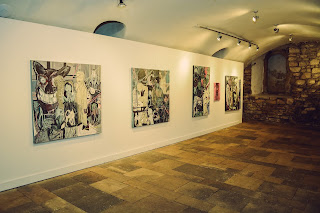

Those complications — of fitting in a society that works on  Lyotard’s theory of language game — spark in artist Tincuța Marin, in the wicked paintings of her own  distorted realities. She lives in Cluj-Napoca and studies painting at UAD; she lives, like every one of us, in multiple -language games- which bring to every one of us distorted views on things – views that even after expressed, will change their meaning in the eyes of the public. The artist reinterprets the common reality and gives us her own, which is a grotesque combination of ugliness, beauty, anxiety, and alienation – all this using her own language game rules.


 Where do the paintings power emanate from? The grotesque atmosphere is only a foyer to the effect. I think Tincuța’s intense awareness of her own emotions  is part of it — how she tries to find a style that would allow her to express herself in simple  gestures, and to be able to express emotion without narrative  clichés— that quest on itself becomes the source of power  for her works. 

That’s what Tincuța’s show at Expo Maraton’s VII-th edition made  me think about, the postmodern self, the search for a game  you can belong in by finding the rules— or creating your own. How do you face those distorted  realities?


photo credits Vlad Dobritan